Another week, another run of

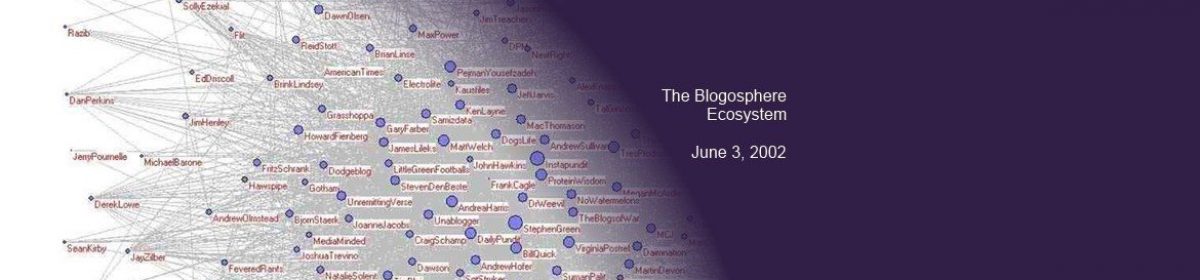
Another week, another run of the ole Ecosystem.

Revised data is up; no major changes to the process this week. Just added a few new blogs on request.

Yes, I’m still trying to automate it; yes, it still takes too damned long, and yes, there’s still some bugs in there (although for the record, with the exception of last Saturday’s screwup, I have yet to see anyone present actual data to prove a bug…. yes, that is a challenge ! )

Anyway, enjoy, don’t take it all too seriously (defined as all values of seriously where seriously > 0 ) and take care…

-NZB

Update: I just uploaded the raw .csv data file of links extracted (unfiltered, so it includes links from blogs-to-themselves as well as links from blogs-to-URLs-not-on-the-list-of-blogs, both of which get filtered out); the link is Please please please do not click on that unless you are seriously attempting to debug; it is 600K even zipped and my bandwidth is running low. Thanks!

Wanted: A Few Good FontsOK,

Wanted: A Few Good Fonts

OK, I’m surprised that I haven’t been able to find this information yet myself, so I’ll put out a call for help.

I’m looking for information regarding which fonts are available on which browsers and platforms. In my dream, I’d like to see a table that lists Times Roman, and then tells me which of the major platforms/browsers have that font. And so on, for every other font in existence (or at least the biggies).

This is, of course, related to the redesign. I hate boring fonts — but I hate unreadable sites even more, so I’m trying to do the best job I can coming up with a slick layout & snappy fonts, but I don’t want it to just look snappy to me and look like crap to everyone else…

Anyway, so far I’ve struck out in finding much info beyond the basics that Arial and Verdana are good. Anybody with a link or two, ’em my way, please.

al Qaeda gophers tape,

al Qaeda gophers tape, declares support for Bush

Yet another al Qaeda spokesminion popped up out of his gopher hole today just long enough to praise Allah & pass an audiotape.

I skimmed the report briefly… al Qaeda organization in tact… blah blah… bin Laden alive… blah blah blah… more attacks coming… blah blah blah. All of it Allah willing, of course.

But the last bit really caught my eye, where the spokescreature referred to the controversy around how much Bush knew pre-September 11:

“…it is a cover for the attack of the Democratic Party on the Republican Party after the America president announced that he knew about the September 11 attacks and big economic problems that the American government is suffering from.”

Is this fellow just being incoherent, or did he just declare that he’s on Bush’s side in the who-knew-what-when argument?

Damn, now if Bush can just get Andrea Yates and Charles Manson to endorse him, he’ll have the coveted psycho-murders trifecta. 2004 will be a lock.

Maybe Daschle needs to offer to build bin Laden a new cave or something; he’s falling way behind here…

Everybody’s favorite ex-D.C.-bureaucrat-turned-Ivory-Tower-academic delivers a

Everybody’s favorite delivers a thorough thwacking to The Nation‘s William Greider, who seems to have come to the interesting (though sadly not unique) conclusion that what’s bad for America must be good for the world.

Greider:

The scandals of Enron et al., unfortunately, must compete with another story–the war on terrorism–that’s more exciting, and threatening, than dirty bookkeeping or the looted billions. The two crises are intertwined in perverse ways. The smug triumphalism of Bush’s unilateralist war policy could be abruptly deflated by economic events–which probably would be a good thing for world affairs, since Washington couldn’t run roughshod over others…

DeLong:

I don’t know which is stranger: the anticipatory schadenfreude at the fantasy of U.S. unemployment climbing toward 15 percent, or the strange and ill-thought-out chain of logic by which a decline in the value of the dollar is supposed to produce a domestic depression and a shift in U.S. foreign policy…This guy was, twenty years ago, one of our best and most incisive reporters. Now his chains of logic snap at the first touch, and his overriding hope appears to be that the flaws in the American economy manifest themselves by throwing a lot of people out of work, so that “the fashionable boastfulness about America… [will] implode…”

Advantage: DeLong !

And here’s a link to the Nation story, since as much as we love Prof D, he still hasn’t quite got the hang of the ole’ link-to-the-story-you’re-spanking thing…

Update: Prof. Delong responds to my gentle chiding: “Hey! I didn’t realize until I read your weblog that the _Nation_ piece was online. You see, I read it in what is called ‘paper’–I realize you may be unfamiliar with the concept. Every week or so, this 48 page flimsy flexible thing arrives at my doorstep… kinda like a regular email but kinda not. Anyway, thanks. I’ve added the link on my website.”

Bizarre. Next he’ll be raving about how he chissels his grocery list into granite tablets…

The Hayman fire has claimed

The Hayman fire has claimed its first lives, if indirectly.

firefighters died last night in a highway crash on I-70 as they were travelling in a convoy en route to the site from Oregon.

My sympathies go out to their comrades, friends and family.

I think yesterday was the

I think yesterday was the first full day since I started blogging with no posting whatsoever.

Sorry folks. Expect light blogging this weekend as well, because a) nobody seems to visit on the weekends b) I have family in town and c) I’m focusing energies on the site redesign for our upcoming relaunch.

I’ll probably drop a few tidbits here and there that catch my eye, but no Deep Thought, I would expect. You’ll all have to go figure out your own moral systems for a few days…

-NZB

From CNN.com :FBI: Terrorists may

From :

FBI: Terrorists may try to arrive by sea

The FBI has received reports that al Qaeda terrorists may be making their way toward Southern California aboard a merchant ship, but has no evidence to back up those reports, the bureau said Wednesday.

The reports indicate that as many as 40 al Qaeda members may have boarded a merchant vessel in the past month and were headed for the United States, FBI spokesman Matthew McLaughlin said. The bureau has placed a “very high priority” on determining their accuracy, he said.

He stressed that the FBI has not gathered any evidence thus far to support the claims and said no terror alert has been issued.

McLaughlin declined to provide details of the reports, but said Catalina Island — about 23 miles off the California coast near Los Angeles — was mentioned as a possible destination.

I find this more than a little personally relevant, given that I can see Catalina out my window.

SoCal warbloggers, unite! I say we meet ’em on the beaches and bore them to death with our overblown rhetoric… (invite Kaus too; get him to bring one of his welfare reform pieces and that’ll really do them in…)

PS – On a more serious note, I can’t think of a more bizarre spot for al Qaeda to pick to deliver 40 (presumably Middle Eastern) men and expect them to go unnoticed. Catalina is a tiny place, with just a few (one?) towns that are entirely tourist traps and tons of really really expensive homes. And the only way between it and the mainland are regular ferries. (Picture forty men of Middle Eastern appearance buying tickets for the ferry from Catlina when nobody at the dock remembers seeing them come to Catlina). If these guys had a boat of their own, I suppose they could sail from Catalina to LA, but then what’s the point of stopping in Catalina in the first place?

I’ve seen a few links

I’ve seen a few links to post below regarding my loss of faith in the Palestinian culture which say something like “N.Z. Bear has given up on a Palestinian state.”

To be crystal clear: I’ve given up on a Palestinian state for now.

When the Palestinians rebuild their culture to value life over death, then I’ll be there with open arms to welcome them into the club of civilized peoples — and support their aspirations for a state.

But at the moment, I’m not holding my breath for that to happen anytime soon.

Okay, the poll on whether

Okay, the poll on whether the Hall of Link Sluttage should be renamed has been up for a while, and it’s getting, well, old. And besides, I have a new poll question I want to put up. So down it comes!

But first, to recap the results:

The Question: Should the Hall of Link Sluttage Be Renamed?

The responses:

5.0 % – Yes, because it’s offensive
19.0 % – Yes, because it’s just not that funny
25.6 % – No, it’s amusing. Don’t change it.
50.4 % – No, it’s not amusing, but don’t change it just to annoy the PC crowd.

One can draw many conclusions from these fascinating pieces o’ data:

1) TTLB readers are a perverse lot, given that more than half indicate that despite finding the HoLS to be a chuckle-free zone, they want me to keep it that way just to annoy other people. That’s just not very nice.

2) The vast majority of folks don’t think the name is amusing; 74.4 % .

3) Only a meager 5% of TTLB readers are easily offended. I’d like to say this comes as a shock, but…

Anyway, I never claimed this was a democracy, so I haven’t yet decided what to do with the silly thing. You’ll just have to wait for the site redesign.

But on to bigger and better things. Speaking of the site redesign:

I’m considering investing some effort in figuring out this RSS thing, which I know next to zip about. Some kind of dark magic whereby folks can subscribe to the site, from what I understand. So anyway, the new poll question is meant to gauge interest in such a feature, and not incidentally, also give me a vague idea of how many folks are checking in on TTLB regularly.

So go vote already !

Reader Vachon wrote in to

Reader Vachon wrote in to comment on proposal for a moral code based on freedom:

I’m wondering, Mr. Bear, if what you are describing as freedom might be better described as opportunity? It goes without saying that “equal freedom” is a non-sequiter: freedom is (at least in this country) completely dependent on economic status, physical health, emotional health, race, gender, etc. Even saying “Dirty Bomb” in an email might endanger my freedom.

So maybe what I would prefer is opportunity, and equal opportunity for all at that. If I had the same opportunity to access excellect health care as say, someone with a General Motors health plan, I would certainly have more freedom. If I had the opportunity to attend college based on my intellect rather than my wallet, I would have more opportunity. If I could lobby my congresspeople the way, say, Enron did, I would have more opportunity to have a government more responsive to me. You get my drift. Freedom sounds great unless you are in that peculiar place where freedom just means having enough money to put gas in the car to go to work to get enough money to put gas in the car. I won’t even begin to wonder if a schizophrenic has less freedom than a manic-depressive, etc. But with equal opportunity, every schizophrenic would have the same opportunity to access those medicines that would give him or her the most freedom.

Regardless of whether you call it “freedom” or “opportunity”, the concept I am attempting to put forth does encompass the kind of choices that Vachon brings up. When I describe what I call freedom, it’s important to note that this is much broader concept than the traditional, patriotic ideal of freedom that we generally think of in America. I am genuinely trying to describe an actual physical reality that exists: what paths can a person follow given their current state?

So while a superficial reading of my earlier post might lead some to suspect that I’m simply arguing a traditional libertarian or even anarchist position — both of which are ideologies that claim to maximize freedom — that isn’t what I’m proposing at all. I completely agree with Vachon that there are many, many factors that must be considered when calculating a person’s “freedom quotient” per my definition: not just those traditionally American values as freedom of speech and religion, but also the simple freedoms that come from having sufficient money, a home, and being well fed.

The moral code I am proposing does not nececssarily lead directly to an anarchist position: quite the contrary, as I would argue that in a true anarchy, the net freedom of such a society is rather low. Nor does it necessarily argue for a pure capitalist position; if it can be argued that government regulation limits the freedom of some entities in a society, but increases the freedom of a much larger set, then such policies can be justified as moral in this system.

A moral code based on freedom can well lead to a support for government policies that even lean towards the socialist, such as universal healthcare. But to be “moral” by this code, such a policy would need to demonstrate that it provides a net increase in freedom to those affected by it (assessing both those who benefit directly and those who pay for it). At a simplistic level, if universal healthcare genuinely provides millions of people with a higher level of health, then I would argue that it has increased their freedom — for certainly a healthy person has more opportunities and choices than one who is ill (or dead). And if the cost were minor, and borne by those who could afford to pay it, they would suffer a decrease in freedom (from having less money), but one that might be offset by the net increase of the beneficiaries. The question to answer when using this moral yardstick is which is more significant, then net increase or the net loss?

Adopting a moral code to “make people free” as opposed to trying to “make people happy” doesn’t guarantee easy answers, by any means. There can still be massive disagreement over what policies would, indeed, maximize freedom. But I still claim that such disagreements are far, far better than those that arise when radically different groups of people attempt to enforce their vision of “happiness” on each other…

Jason Rylander notes the annnoucement

Jason Rylander notes the annnoucement of a course in blogging from UC Berkeley’s school of journalism, and asks whether that us all professors.

Of course not, Jason. We have practical and deep experience in the subject at hand: that totally disqualifies us to be professors at most Universities…

From FoxNews (courtesy of Mr.

From (courtesy of Mr. McGehee ) :

Wednesday, June 19, 2002

WASHINGTON – Moroccan authorities have arrested a senior Al Qaeda recruiter known as “The Bear” who is suspected of plotting attacks against Western interests in Morocco, U.S. officials said Tuesday.

Abu Zubair al-Haili, a Saudi who weighs more than 300 pounds, is considered among the top 25 Al Qaeda lieutenant of Usama bin Laden, the officials said, speaking on the condition of anonymity.

Let’s be clear on this:

1. I am not from that part of the Arabian penninsula currently dominated by the House of Saud.

2. I weigh considerably less than 300 pounds

3. I remain at liberty.

You know, you would think I could come up with something funnier than that to say about this, but I’m just not up to humorous comparisons between myself and a murderous thug. Excuse me, alleged murderous thug. Maybe after I get my coffee.

No Palestinian State… For Now

Armed Liberal has up on the idea of a Palestinian state.

And for me also, this week has been a turning point. Maybe it was the compelling argument of why a Palestinian state can’t possibly exist now, or maybe it was the latest atrocity. (Did anyone check to see if Arafat’s ritual condemnation came after, or before the bombing? )

Or maybe I’m just tired of the stupid bastards destroying their own lives and striving to take as many of those around them with them as possible.

There are decent and moral Palestinians; men and women who do not wish death and destruction on their neighbors; who want only to live normal lives in peace. I am convinced of this; I have to be, for to imagine an entire people so depraved as to be without possibility of salvation is a thought so black I can’t contain it in my mind. So I cling to that article of faith that there are Palestinians who do not regard the deliberate murder of children as a valid expression of “resistance”.

But it seems self-evident that at this point, there simply aren’t enough of them to matter.

I don’t wish death or even suffering upon the entire Palestinian people. I don’t even want them driven out of the West Bank and Gaza, as some have suggested — and not in jest, I suspect.

But I am past the point of believing that they, as a people at this point in time, have a right to a state. Nor can they be trusted with even the basic freedoms a civilized society should expect and aspire to.

Israel’s policy of moderation — and that is what it has been, despite what you’ve heard — has failed. And it will continue to fail so long as Israel allows the pseudostates which the PA has created in the West Bank and Gaza to continue to fester.

It is not time for yet another incursion into the territories, to be followed by a pullout in a few days. It is time for Israel to take full control of the West Bank and Gaza. All of it. And it is time for the complete and total disarming of the Palestinian people. No armed PA security force(s). No militias. No police. No guns, no bombs, no mortars, nothing. Israel should sweep in, and when they do, they should pack for a long stay. For they will have to be there a long, long time.

The Palestinian people will suffer; many of them will be innocent. They will have few of the basic freedoms that they should as human beings expect. They will live in a true police state. And for this, I am sorry. But while I remain sympathetic to the individual Palestinians who are truly blameless, my tolerance for the vile behavior of the Palestinian society is at an end. It is a sick and diseased creature in its current state, and it should be put down. In time, perhaps, a new culture can be grown in its place; one that satisfies the aspirations of the Palestinian people while not reflexively bringing murder to its neighbors.

To be clear: this is not a call to genocide. It is not even a call to violence. Where Palestinian society calls for death to reign down upon their enemies the Jews, I know that the Jewish state will continue to demonstrate that it is indeed a civilized nation, worthy of those terms. There will be no massacres. There will be no mass graves. There will be incidents, there will be mistakes. People will die who should not have. But they will, on balance, be just that: mistakes. Not the deliberate acts of barbarism that the Palestinian culture has elected to make its tool of choice.

And what should we, America, be doing while this housecleaning is taking place? Fixing the real source of the problem: the corrupt and twisted regimes that finance psychotics like Hamas in the first place. Syria. Saudia Arabia. Iraq.

The conventional wisdom has been that once the Palestinian question is resolved, we will have a freer hand to work through the other issues plaguing the region.

The conventional wisdom has it exactly backwards. Even with the brutal course I propose of a full Israeli takeover of the territories, there will still be terror and death so long as the money and arms continue to flow from the regimes who benefit from such violence.

Even Israel does not have the might to address all of these petty fiefdoms of blood all at once.

But I know a nation that does.

Let us hear no pathetic cries of “national sovereignty” and “American imperialism”. Let us ignore those who will rise to defend the tyrants and the murderers out of reflexive allergy to “Western hegemony”.

And let us simply hope that our society has the collective will to know what must be done, and to do it.

Diana Hsieh has yet another

Diana Hsieh has another bizarre twist in the cause of the Hayman fire. Apparently, the woman accused of setting the fire is now being accused of doing so deliberately — prosecutors claim to have evidence that contradicts her prior statement, in which she claimed she started a small fire to burn a disturbing letter from her estranged husband which then escaped out of control.

Life, Liberty, and the Pursuit of Happiness

Life, Liberty, and the Pursuit of Happiness. In that order.

Moral codes are tricky things. Dangerous, even. Even with the most straightforward of intentions, after a few generations or so of interpretation, they have a tendency to spin wildly out of control. You start out with a set of rules that are meant to ensure that people treat each other decently, and you end up with people blugeoning each other to death with your holy tablets.

In our world, the nice thing about moral codes is the same thing that’s nice about standards: there’s so many to choose from. In today’s exercise, I humbly propose to examine some of the prevailing moral codes that currently bestride the planet, and in the end, propose a new — or at least, newly argued — one. Heady stuff, indeed — so let’s see if I can firewalk these coals without getting too badly burned.

The first option most folks consider when shopping for a moral code is what we in the software business like to call a “packaged system”. Take it out of the shrink-rap, a bit of installation, and you’re ready to run — soup to nuts. No muss, no fuss, no thought required — or encouraged. The biggest vendors in this particular market are of course the major established religions of the world. Islam, Christianity, Judiasm: all come complete with often surprisingly detailed instructions for exactly how to tell right from wrong; good from evil. Happily, the Big Three tend to agree on which category the vast majority of things fall into. Less happily, the small percentage of things which they disagree on has fed enough hard feelings to keep the planet pretty well engulfed in war for the past few millenia.

The Big Three aren’t the only game in town, of course: there are more religions begging to tell you exactly how to live your life than you can shake a stick at. (Just try it sometime, you’ll run out of shake or stick real fast). But religions aren’t the only packaged systems out there by any means.

You can also get all the benefits of a packaged system without any of that tedious God stuff, if that kind of thing troubles you. Marxism, Socialism — pretty much anything ending in “ism” will get you up and running with a set of ideas that are meant to be taken as fundamental truths; ideas that you can live your life by.

But what if the idea of a packaged system doesn’t appeal? Not a problem: roll your own.

The folks who roll their own moral codes are generally an ornery, sometimes even antisocial lot. Usually, they’ve flat-out rejected the Big 3’s pretentions to own universal truth; often they label themselves agnostic, atheist, or even (the grumpier ones) antitheist. And they don’t necessarily like the idea of the “isms”, either; the idea of having their moral system handed to them on a plate makes them inherently suspicious. Unfortunately, by telling you what they are against, they haven’t actually told you what they are for.

So how do most people who roll their own moral code do it? Usually, they start with a fundamental principle which they feel is the most important to uphold in their lives. And it seems that however they phrase it, most folks tend to pick the same general idea: do unto others as you would have them do unto you. Or: Do no harm.
Or: maximize happiness in the world. Make people happy.

These all reduce down to the same basic fundamental concept — and its the same one generally followed by those who haven’t ever even thought in any explicit terms about their own moral code: to maximize “happiness” in the world, and minimize “suffering”. Do good, not bad.

This sounds great, on a superficial level. But I am here to argue that it’s an absolutely lousy foundation to build a moral framework on.

The biggest problem is that “happiness” and “suffering” are totally and unavoidably subjective measures. Nobody is ever going to be able to define human happiness in a way that would allow an objective scale of it. You wouldn’t even know where to start. Is physical pleasure happiness? Emotional joy? Which is more important? How about satisfaction from a job well done?

It’s a mess. Most people don’t even stand a chance of assessing their own happiness — let alone judging what makes other people happy. And yet that basic assumption — that you can objectively assess what will make other people happy — lies at the heart of the moral systems on which a very large number of people on our fair planet base their decisions on, day in and day out.

So what happens? You end up with perfectly well meaning people — people following that nice moral code — who disagree about what happiness is. And guess what? They start thinking that they can decide what will make other people happy. Unfortunately, those other people don’t particularly like the idea of happy that the first group of people came up with for them, which of course makes the first group pissed off that the ungrateful bastards aren’t appreciating all the happy they’ve got in store for them — and soon enough, before you know it you’re back to people getting whacked over the head with stone tablets.

OK, smartguy, you say, that’s all fine and good. But it’s a moral system, man, it’s got to be subjective. Haven’t you ever heard of moral relativism?

Shudder. Let’s just say we’ve met, and that it didn’t go well.

I will accept, that in a truly rigorous scientific sense, there’s no way to build a truly, 100% objective moral system. At the heart of it, you’ve got to pick something — some principle to start with that you decide is more important than the infinity of other possible principles that you could have selected. And I don’t think there’s really any way to objectively and/or scientifically argue that any one principle is “better” than any other in a rigorously proveable sense.

But…. but! If you pick the right starting principle to use as your foundation, I claim you can arrive at a system that from there on up can be completely objective.

I’ve already argued that nice as it sounds, “happiness” makes a crummy first principle for a moral system. It’s just too squishy, too difficult to measure — too subjective. So we need something more rigorous, something that can actually be judged objectively. Something that you could legitimately measure and, more importantly, measure in a way that two different people would come up with the same answer. And not so incidentally: it would certainly be nice if the value was something that you truly believed was a valuable and good thing (and yes, that’s subjective). A thing that you’d be comfortable living in a world where it — whatever it is — is the most important thing to everyone.

And so my modest proposal: Freedom.

Yup, freedom. Big lead up just to get to that, right? Freedom; everyone’s for freedom. Duh. You made me read this whole boring thing just to get to freedom?

But I challenge you to bear with me, and think through the implications of replacing that squishy “make people happy” in the standard model moral system with “make people free.”

The implications, I think, are subtle, but profound. And the reason is that freedom is actually a concept that, theoretically at least, can be measured objectively.

Think of every human life as a decision tree starting at birth, and branching outward in a huge forrest of possible decisions and actions that all, eventually, lead down a path to that person’s eventual demise. Some paths are short; some are long. At any given moment, you can picture a person sitting at one spot on that tree of possibilties. And he’s got a finite set of options at any moment; a finite set of choices that will lead him down the paths of his life. At some moments, he’ll have many paths to choose from — at others, he’ll have few.

To use a crude example; a man in a maximum security prison serving a life sentence without parole has a very low freedom quotient, becaus
e in a very rigorous sense, he simply doesn’t have many branches to choose from. Whereas that same man, were he never to have been convicted, would have a significantly higher quotient.

Of course, we don’t have any way to actually rigorously measure the exact freedom quotient of a person. But just because we can’t take the measurement doesn’t mean the value doesn’t exist. And yes, we’ll still have arguments between people who, examining the same set of possible course of actions, disagree as to which course will maximize freedom. But I argue that comparing these potential disagreements with the ones we’re already stuck with over what will increase “happiness” argues strongly in favor of a freedom-based code. People arguing over what will maximize freedom would look like two refs arguing over whether the ball was in the end zone or not. There’s an objective answer, but neither one has a perfect way to measure reality to get at it. People arguing about maximizing happiness, on the other hand, are analagous to those same two refs arguing —except one of them thinks the game is football, and the other thought they were judging hockey.

This is not to say that happiness has no place in a moral system. Particularly in small-scale, interpersonal relations, it is not clear to me that applying the freedom-test really tells you much about how you should act. (Will it “increase freedom” if I do a favor for a friend? If no, does that mean I shouldn’t do it?). And so I think that there is still a place to fall back on the old “what do I think will increase happiness” question. But only after you’ve tried to find a course that maximizes freedom.

I’ve been mulling this idea over in my mind for some time, struggling to find an appropriate way to convey my thoughts. And tonight, it struck me that some very wise men already laid out the roadmap — intentionally, or not, I’m not historian enough to know for sure. But it is there, if you look for it:

Life: For without preserving life, there is nothing.

Liberty: Because freedom is the foundation upon which all else rests.

The pursuit of happiness: For when maximizing freedom doesn’t tell you which way to go.

It’s all there. Just make sure you get the order right.
Cool. Looks like at least

Cool. Looks like at least one person took call for more bloggers seriously — Alex Slinin wrote to say he took my message “to heart” and now has his very own blog. So welcome Alex and his Pixelated World to the blog block.

And I think Alex gets the dubious honor of being the first new blogger I’ve directly inspired. Doubly cool.

Now if he was only a mom, and played soccer… no, wait, that’s not right…

Correction: Poor neglected Jim over at Jimspot wrote in to correct this senile old bear: he gets the dubious honor of being the first bear-inspired blog, and provides this post as evidence. (And I remember reading it, too, which just goes to show how good my memory is… sorry, Jim — and thanks for the kind words ! )